 Politically active Christians fight for policies they feel support their god's agenda. In this statement of belief about why Christians should be politically active, Michigan businessman, inspirational speaker, and born-again Christian Stacy Swimp argues that "True Christians have a responsibility to God to fight any law or policy
that would violate God’s will and, in the end, our own conscience."
Politically active Christians fight for policies they feel support their god's agenda. In this statement of belief about why Christians should be politically active, Michigan businessman, inspirational speaker, and born-again Christian Stacy Swimp argues that "True Christians have a responsibility to God to fight any law or policy
that would violate God’s will and, in the end, our own conscience."Swimp and other politically active Christian leaders urge believers to engage in the entire process from prayer to the polling place, and to work in private, in small groups, and in crowds in an effort, as Swimp articulates, to remove " the demonic stronghold which has, for decades, lead us down the path of moral relativism, socialism, broken families, record levels of unemployment, and leadership that has forgotten that righteousness exalts a nation!"
Taking a shot at Swimp for his hasty generalizations would be easy enough, but he is here not as a punching bag, but as an example of Christian political activism and an introduction my argument that, from the perspective of a believing Christian, political activism has no bearing on political outcomes, and from the perspective of a non-believer, Christian political activism seems almost contradictory to the faith's tenets.
Let's begin with solidarity. While Christians in general claim the same broad beliefs, their politics (and indeed their doctrine, but that is best left to a shelf of books) are anything but homogeneous. What one might support depends on one's particular sect. Let's take a look at two politically active Christians' views on the minimum wage. The first, Stacy Swimp, you've already met.
 |
| Stacy Swimp |
 |
| Charles Clark |
So how does God decide which view to support? Is there some sort of polling switchboard and He just goes with the majority? How does He weigh the prayers and protests and votes of politically active Christians on opposite sides of an issue or who take various differing positions within an issue?
Actually, Christian religious texts have the answer to these questions, and at least for those who take the Bible as truth (often spelled with a capital "T"), reveal that for true believers, activism intervention can have no possible impact on the outcome of any political struggle.
Let's postulate (if you aren't Christian) or present as a given (if you are Christian) that:
The Abrahamic god worshiped by Christians exists. I will, according to convention, use the masculine pronoun and refer to him using the proper pronouns "Him" and "He" and the proper noun "God."
God is omnipotent. He can exert His will over anything in His creation at any time or any place simultaneously. Nothing can resist His power.
"And I heard as it were the voice of a great multitude, and as the voice of many waters, and as the voice of mighty thunderings, saying, Alleluia: for the Lord God omnipotent reigneth." (Revelation 19:6).
God is omniscient. He knows all things at all times, including the past actions, ongoing actions, and future actions of everything in His creation. Nothing is hidden from Him, including even the most fleeting thought.
"I am God, and there is no other; I am God, and there is none like me, declaring the end from the beginning and from ancient times things not yet done, saying, ‘My counsel shall stand, and I will accomplish all my purpose.'" (Isaiah 46:9-10).
God is omnipresent. He is everywhere at all times and in all places and has been and will be for all eternity. God's presence cannot be escaped.
"Nothing in all creation is hidden from God’s sight. Everything is uncovered and laid bare before the eyes of him to whom we must give account" (Hebrews 4:13).
God has a plan for His creation. He has a plan not only for the larger scheme of things, but also the lives of every individual creature, including and especially humans, in His creation.
"This Jesus, delivered up according to the definite plan and foreknowledge of God, you crucified and killed by the hands of lawless men" (Acts 2:23).
Because of His overwhelming power, it is quite easy for Him to affect His plans. He enacts His larger plans through the actions of individuals and groups of individuals regardless of the personal desires of those individuals.
This, for example, occurs in Exodus when God tells Moses to ask Pharaoh for release, but apparently for PR reasons, God says to Moses, "I will harden Pharaoh's heart that I may multiply My signs and My wonders in the land of Egypt" (Exodus 7:3). Pharaoh may well have let Moses and his crew go without all the death and pestilence, or maybe just after Aaron did the whole my-snake-rod-swallows-all-your-snake-rods thing, but that was not part of God's plan.
 |
| Dude, your breath. |
Neither Satan nor Judas had any say in the matter. I suppose you could argue that Satan could have refused God, or failed to have been manipulated into possessing Judas, but that would contradict God's omnipotence.
All this helplessness in the face of an almighty deity means that if you are believer, you can take solace in knowing that even though your prayers were not answered, God heard them and didn't answer them for a reason, or He answered them in unexpected ways because it was all part of His plan.
God's plans are immutable and the individual's wants are secondary, if not irrelevant. He already knows the outcome of everything in His creation across all time and is present and powerful in each every moment. You can't surprise Him and He can't surprise Himself.
Thus, whatever path the United States body-politic is taking is being directed by God through the actions of individuals and groups of individuals whether they know it or not or whether they think their actions are making a difference or not.
By way of example, the striking down of DOMA was all part of God's plan and the exertions of protestors on both sides of the argument were also part of His plan. Like Pharaoh and Moses and Satan and Judas Iscariot, Christians might argue that yes, of course the DOMA defeat is part of God's plan. He want us to demonstrate our loyalty and commitment by fighting more strongly for His will in our nation and is testing our worthiness through political martyrdom and ability to suffer. But this doesn't make any sense because, being omniscient, He already knows the personal commitment and worthiness of every single individual.
So why do some believers feel that "good Christians" are politically active Christians? If you are not a politically active Christian, are you are something less than "good." Does that mean you are bad? Does God prefer the firebrand over the hermit? Will a prayerful, reflective, honest, introverted, studious true believer be cast out of Heaven and a prayerful, honest, exuberant, publicly passionate extrovert be welcomed? Real Christians know these are rhetorical questions.
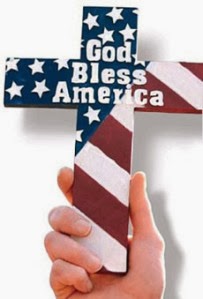 |
| Or not, Your call |
One argument made by some religious leaders that good Christians must be politically active in order to influence the levers of power to push the United States to become a moral and righteous nation, a more Christian democracy.
But again, it won't make any difference. If God needs America to become a Western European democracy with a single-payer health care system and extensive social safety net with legalized abortions, so that later he can condemn the damn place to sulfur and brimstone, then no amount of good Christian influence is going to make any difference. If, on the other hand, He chooses to take America to the brink and save her, then He has already planned it (and relative to His existence, it has already occurred and is occurring) and He'll do it without his followers' puny exertions.
For non-believers my argument is simply a thought exercise. They understand that political activism does have effect on the outcome of political struggles, and they also understand that religion plays a big part in people's lives. Thus, non-believers realize that religious beliefs can be manipulated or invoked or rallied to successfully gain the upper hand in political contests.
For believers it is a bit more complex. They cannot be fighting for personal gain, because through faith they already have achieved the Kingdom of Heaven and in the blink of an eye will be reunited for eternity with their deity.
They also cannot believe that their exertions will help anyone God doesn't want to be helped or change anything God doesn't want changed.
This excerpt from Chapter 9 of Paul's Epistle to the Romans sums up the whole exercise:
For He says to Moses,“I will have mercy on whom I have mercy, and I will have compassion on whom I have compassion." It does not, therefore, depend on human desire or effort, but on God’s mercy. For Scripture says to Pharaoh: “I raised you up for this very purpose, that I might display my power in you and that my name might be proclaimed in all the earth." Therefore God has mercy on whom he wants to have mercy, and he hardens whom he wants to harden.
The research clearly shows that once you raise the minimum wage, the
whole bottom wage structure rises with it. The last study that I saw
found the bottom 40 to 50 percent of wages start to creep up once you
raise the minimum wage. That’s a way of creating rules to push people up
- See more at:
http://www.uscatholic.org/blog/201306/catholic-case-raising-minimum-wage-27483#sthash.e6mDhtU5.dpuf
The research clearly shows that once you raise the minimum wage, the
whole bottom wage structure rises with it. The last study that I saw
found the bottom 40 to 50 percent of wages start to creep up once you
raise the minimum wage. That’s a way of creating rules to push people up
- See more at:
http://www.uscatholic.org/blog/201306/catholic-case-raising-minimum-wage-27483#sthash.e6mDhtU5.dpuf


